
Insight 06 January 2025
Progress Architecture
Engineering Organisational Momentum
Organisational performance isn't just about setting goals but designing human systems that create consistent forward motion. Through our work with global organisations, I've observed that the difference between high-performing and average organisations often lies in what I call their 'Progress Architecture.'
Understanding Progress Architecture
Progress Architecture is a deliberate framework that connects daily activities to organisational purpose while creating visible momentum. Think of it as the managerial equivalent of a well-designed building - every element serves a functional and strategic purpose, working together to create something greater than its parts.
Understanding Progress Architecture
Progress Architecture is a deliberate framework that connects daily activities to organisational purpose while creating visible momentum. Think of it as the managerial equivalent of a well-designed building - every element serves a functional and strategic purpose, working together to create something greater than its parts.
The Foundation: Purpose-Connected Progress
The base layer of any effective Progress Architecture must connect individual effort to organisational purpose. A global technology firm we worked with recently transformed its performance by mapping how each team's daily activities contributed to customer impact. This wasn't just a theoretical exercise—they created visual connections between routine tasks and customer success stories, making purpose tangible in daily work.
The Foundation: Purpose-Connected Progress
The base layer of any effective Progress Architecture must connect individual effort to organisational purpose. A global technology firm we worked with recently transformed its performance by mapping how each team's daily activities contributed to customer impact. This wasn't just a theoretical exercise—they created visual connections between routine tasks and customer success stories, making purpose tangible in daily work.
The Structural Elements
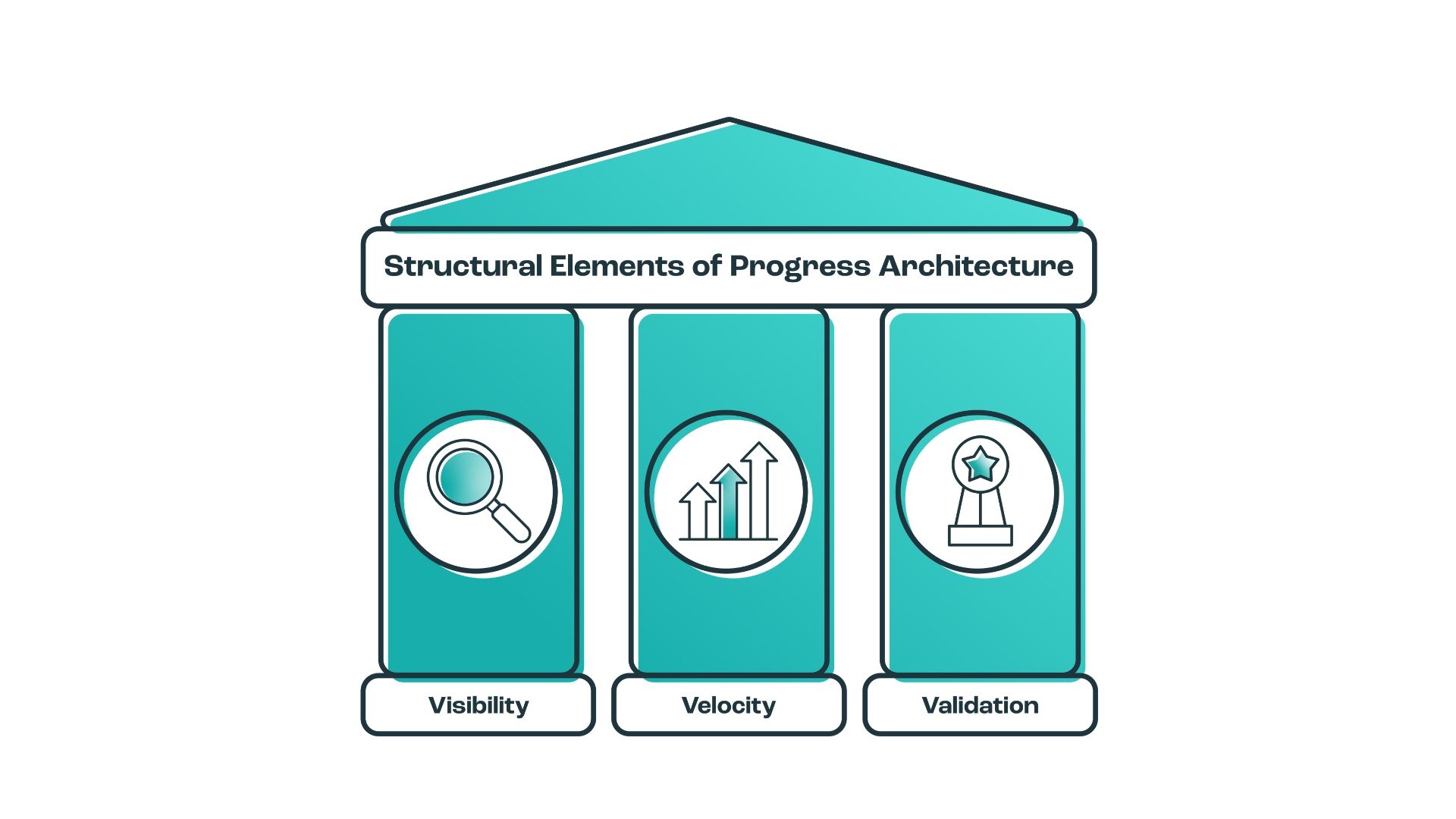
The framework requires three key structural elements: Visibility, Velocity, and Validation.
Visibility involves creating clear sight lines to progress at every level. One Defence industry client implemented digital progress walls showing real-time team achievements, customer impact, and milestone progression updates. Within months, this transformed their culture from task-focused to progress-oriented.
Velocity focuses on removing obstacles to daily progress. This means establishing clear decision rights, ensuring resource availability, and creating rapid response systems for progress blockers. A professional services organisation we worked with reduced their decision-making layers from seven to three, immediately accelerating their ability to move forward.
Validation creates regular confirmation of progress impact. This isn't about endless metrics - it's about meaningful measurement that connects progress to results and results to purpose and impact. Regular 'Progress Impact Reviews' examine what was achieved and how it contributed to organisational purpose and at the team level individual purpose.
The Structural Elements
The framework requires three key structural elements: Visibility, Velocity, and Validation.
Visibility involves creating clear sight lines to progress at every level. One Defence industry client implemented digital progress walls showing real-time team achievements, customer impact, and milestone progression updates. Within months, this transformed their culture from task-focused to progress-oriented.
Velocity focuses on removing obstacles to daily progress. This means establishing clear decision rights, ensuring resource availability, and creating rapid response systems for progress blockers. A professional services organisation we worked with reduced their decision-making layers from seven to three, immediately accelerating their ability to move forward.
Validation creates regular confirmation of progress impact. This isn't about endless metrics - it's about meaningful measurement that connects progress to results and results to purpose and impact. Regular 'Progress Impact Reviews' examine what was achieved and how it contributed to organisational purpose and at the team level individual purpose.
The Living Systems
For Progress Architecture to work, it must function as a living system. This means creating:
Progress Rhythms - Regular planning, action, and reflection cycles that maintain momentum. These rhythms should align with natural business cycles while creating consistent forward motion.
Connection Points - Deliberate intersections where individual progress and purpose connects to team achievement and organisational success and purpose. These aren't just meetings - they're momentum-building moments that amplify progress.
Learning Loops - Systems that capture and apply insights about what enables or inhibits progress, creating ever-improving momentum.
The Living Systems
For Progress Architecture to work, it must function as a living system. This means creating:
Progress Rhythms - Regular planning, action, and reflection cycles that maintain momentum. These rhythms should align with natural business cycles while creating consistent forward motion.
Connection Points - Deliberate intersections where individual progress and purpose connects to team achievement and organisational success and purpose. These aren't just meetings - they're momentum-building moments that amplify progress.
Learning Loops - Systems that capture and apply insights about what enables or inhibits progress, creating ever-improving momentum.
Implementation Framework
Building practical Progress Architecture starts with first assessing your current progress patterns. Understand where momentum naturally builds and where it stalls in your organisation. Map the invisible barriers that slow progress and the enablers that accelerate it.
Next, design your progress infrastructure. Create systems that make progress visible, validate forward motion, and connect individual effort to personal purpose and organisational impact. Establish clear progress pathways that show how daily activities build toward larger goals.
Finally, implement progress activation points - regular moments where progress is recognised, celebrated, and amplified. These create the cultural reinforcement needed for sustained momentum.
Implementation Framework
Building practical Progress Architecture starts with first assessing your current progress patterns. Understand where momentum naturally builds and where it stalls in your organisation. Map the invisible barriers that slow progress and the enablers that accelerate it.
Next, design your progress infrastructure. Create systems that make progress visible, validate forward motion, and connect individual effort to personal purpose and organisational impact. Establish clear progress pathways that show how daily activities build toward larger goals.
Finally, implement progress activation points - regular moments where progress is recognised, celebrated, and amplified. These create the cultural reinforcement needed for sustained momentum.
The Impact
Organisations with well-designed Progress Architecture typically see:
-
Increased employee engagement as people experience daily progress and connection to their own individual purpose
-
Faster execution as barriers to progress are systematically removed
-
Better strategic alignment as progress connects clearly to purpose
-
Improved performance as momentum builds systematically
The Impact
Organisations with well-designed Progress Architecture typically see:
- Increased employee engagement as people experience daily progress and connection to their own individual purpose
- Faster execution as barriers to progress are systematically removed
- Better strategic alignment as progress connects clearly to purpose
- Improved performance as momentum builds systematically
Getting Started
Start by examining your organisation's current progress patterns. Where do you see natural momentum? Where does progress stall? How visible is progress at every level? Use these insights to begin designing your Progress Architecture.
Remember, like any good architecture, this isn't about creating rigid structures - it's about designing systems that enable natural flow while providing necessary support. The goal is to make progress not just possible but inevitable.
Getting Started
Start by examining your organisation's current progress patterns. Where do you see natural momentum? Where does progress stall? How visible is progress at every level? Use these insights to begin designing your Progress Architecture.
Remember, like any good architecture, this isn't about creating rigid structures - it's about designing systems that enable natural flow while providing necessary support. The goal is to make progress not just possible but inevitable.
Further Reading

Copyright © 2025 Potenture
Don't miss your chance to join The Purposeful Life


Seven Core Capabilities Guide Available Now!